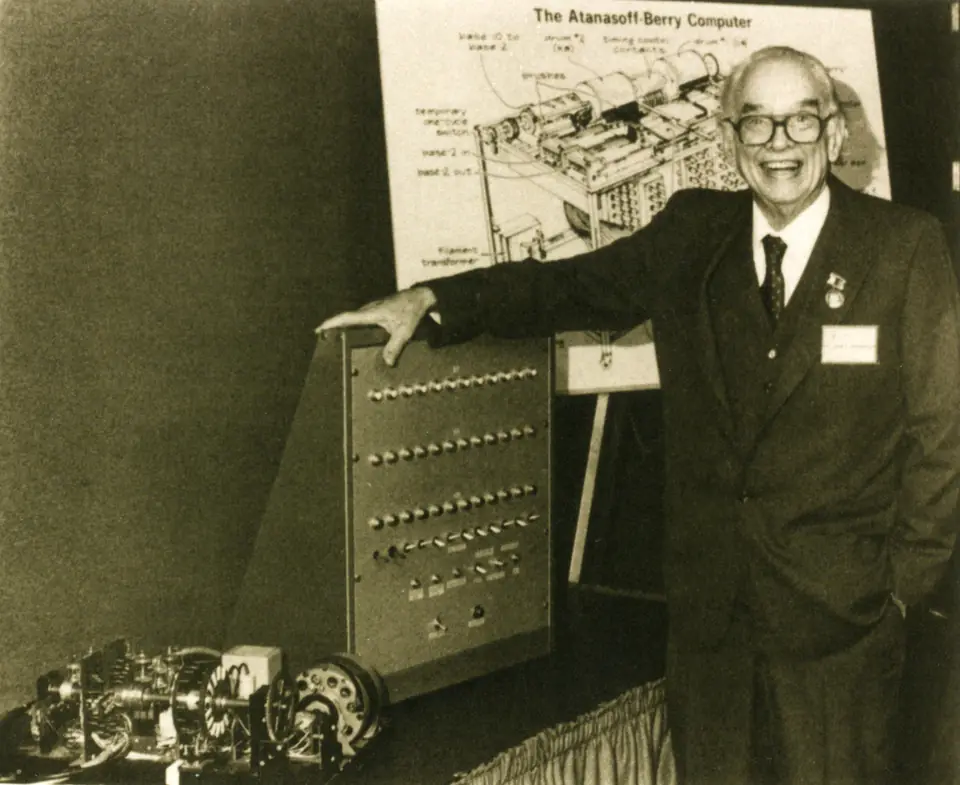
Atanasoff–Berry Computer, or ABC, emerged at Iowa State College as an ambitious answer to a specific problem: solving large systems of linear equations. The working prototype demonstrated electronic binary arithmetic in 1939.
01 / THE FIRST STEP
From a grant to a prototype.
In 1939, Iowa State College provided an initial grant of $650. Atanasoff recruited the young electrical engineer Clifford Berry, and together they began putting each theoretical idea to the test.
By late 1939 they had demonstrated a working prototype capable of electronic addition and subtraction with binary numbers. This demonstrated the core circuits, not that the eventual full-scale machine operated reliably end to end.
02 / THE LARGE MACHINE
Drums, tubes and dozens of equations.
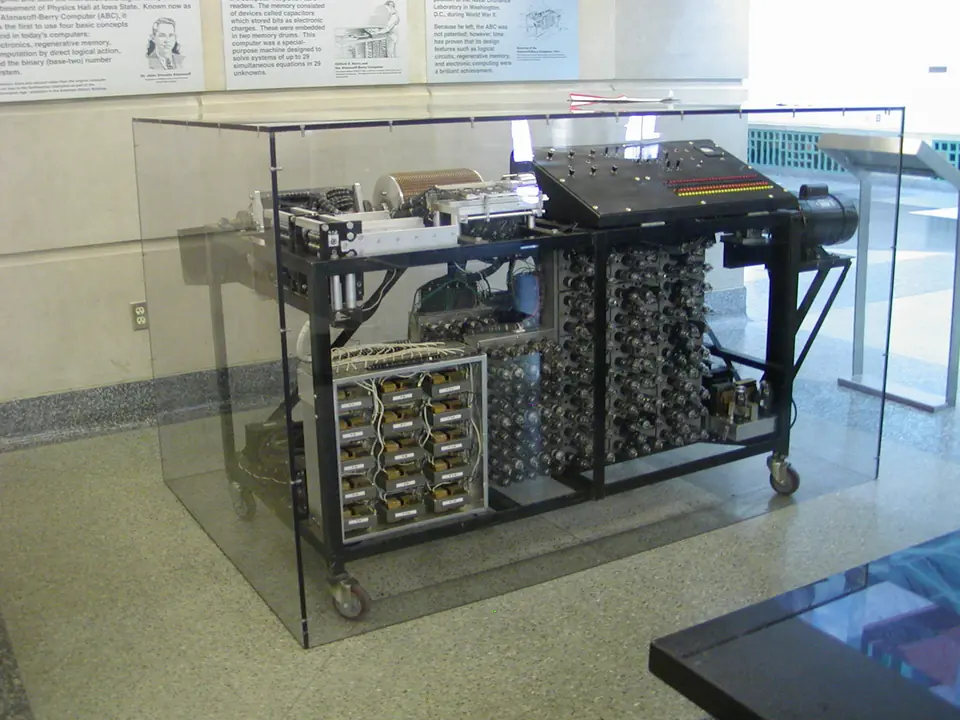
ABC used approximately 300 vacuum tubes, rotating memory drums with capacitors and an internal binary representation with 50-bit number words. It was designed to solve systems of up to 29 simultaneous linear equations in 29 unknowns.
It was a special-purpose device, not a general-purpose programmable computer. It carried out a predefined class of mathematical procedures. Intermediate results were recorded on specialised sheets using a system that remained difficult to make reliable.
03 / WORK INTERRUPTED
War changes the course.
In 1941, John Mauchly visited Iowa and examined the work on ABC. Soon afterwards, the Second World War redirected the team towards military projects, preventing ABC from reaching broader use.
The original machine was dismantled in the late 1940s. A working reconstruction made at Iowa State University in the 1990s helps explain its design.
The 1997 working reconstruction confirmed the electronic principles of the ABC, but it must not be confused with the original machine. The original intermediate card recording and reading system never became reliable enough for the complete apparatus to operate consistently. The reconstruction was relocated to the Computer History Museum in California in March 2010.